
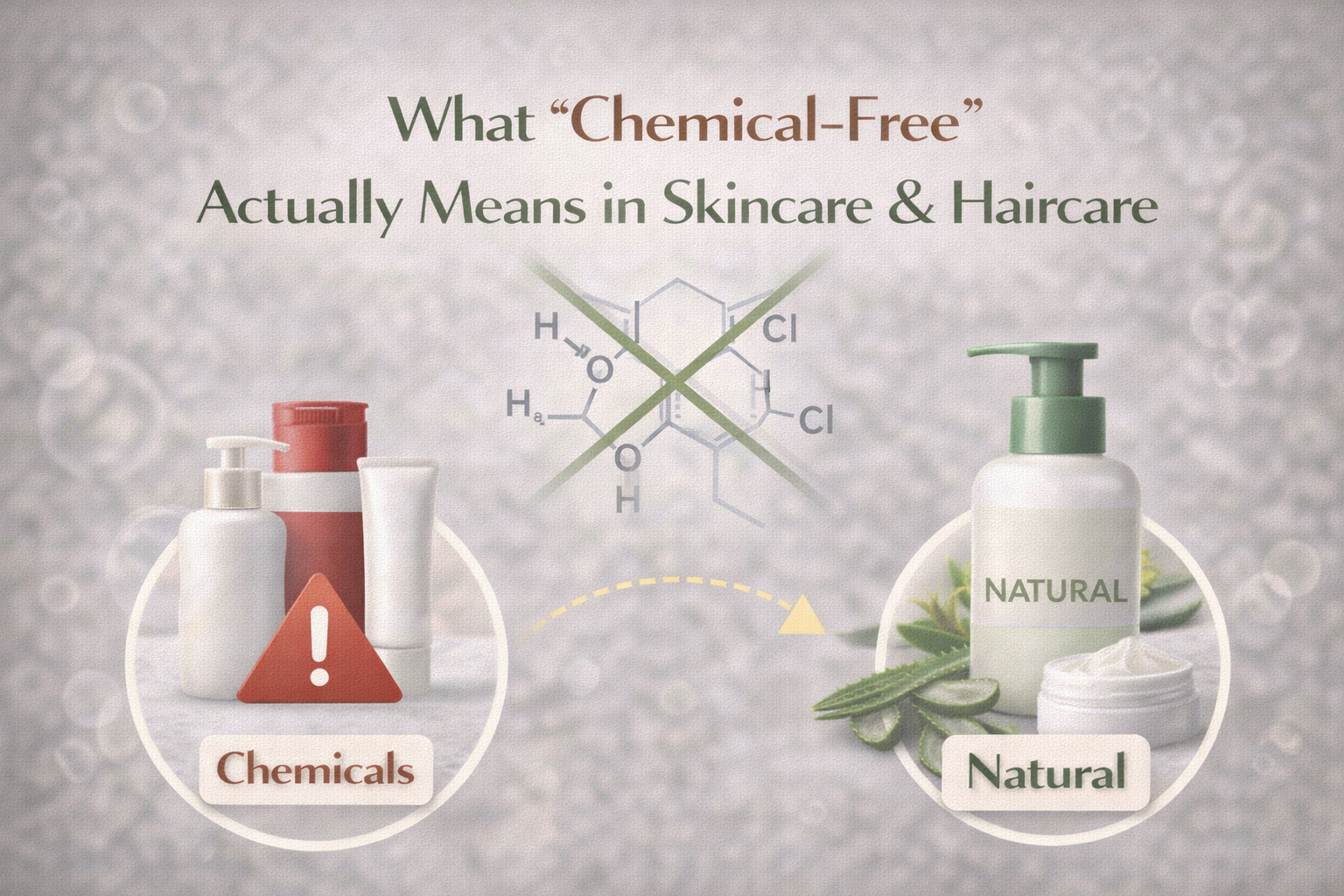
The term chemical-free is everywhere in skincare and haircare marketing. From face creams to shampoos, many products proudly claim to be free from chemicals, promising safer and more natural care. But have you ever stopped to ask what does chemical free mean in reality?
The truth is more complex than marketing slogans suggest. Understanding what chemical-free actually means can help you make smarter choices, avoid misleading claims, and choose products that truly support your skin and hair health. In this blog, we’ll break down the science, clarify label terminology, and explain which claims deserve a closer look.
Understanding the Basics of Chemicals
Before diving into labels and claims, it’s important to understand one key fact:
Everything is made of chemicals.
Water is a chemical. Oxygen is a chemical. Plant extracts are chemicals. Whether an ingredient is natural or synthetic, it is still a chemical substance. So when brands say chemical-free, they are not being scientifically accurate.
This doesn’t mean the product is bad, it means the wording is often simplified or exaggerated for marketing purposes.
What Does “Chemical-Free” Usually Mean?
When brands use the term chemical-free, they typically mean one of the following:
No Harsh or Controversial Chemicals
Most often, brands are referring to the absence of ingredients commonly perceived as harmful, such as parabens, sulfates, or certain preservatives.
No Synthetic Ingredients
Some brands use chemical-free to imply their products are made only with naturally derived ingredients, even though those ingredients are still chemical compounds.
Gentler Formulations
In many cases, chemical-free is used to suggest that a product is mild, non-irritating, or suitable for sensitive skin.
Understanding this context helps clarify what chemical free means beyond the label.
Natural vs Synthetic
One of the biggest misconceptions in skincare and haircare is that natural automatically means safer than synthetic.
Natural Ingredients
Natural ingredients come from plants, minerals, or animals. While many are beneficial, some natural substances can still cause irritation or allergic reactions.
Synthetic Ingredients
Synthetic ingredients are created in labs, often to improve stability, safety, or performance. Many synthetic ingredients are well researched and gentle on the skin.
Safety depends on formulation and concentration, not whether an ingredient is natural or synthetic.
Why “Chemical-Free” Is a Marketing Term
Chemical-free is not a regulated term in the skincare or haircare industry. This means brands can use it freely without meeting specific scientific criteria.
Why brands use it:
- It sounds reassuring
- It appeals to clean beauty consumers
- It simplifies complex ingredient science
However, relying only on this claim can lead to poor purchasing decisions.
Ingredients Commonly Avoided in “Chemical-Free” Products
While the term itself is misleading, many products labeled chemical-free do avoid certain ingredients that consumers prefer to limit.
Commonly excluded ingredients include:
- Parabens
- Sulfates
- Synthetic fragrances
- Formaldehyde releasing preservatives
- Certain drying alcohols
Avoiding these may benefit some skin and hair types, but exclusion alone does not guarantee effectiveness or safety.
How to Read Skincare and Haircare Labels Properly
Instead of focusing on front-label claims, learning how to read ingredient lists is far more useful.
Tips for reading labels:
- Ingredients are listed in descending order of concentration
- The first 5–7 ingredients make up most of the product
- Look for ingredients that support hydration and barrier health
- Watch for irritants if you have sensitive skin
Understanding labels gives you real insight into what you’re applying to your skin and hair.
Marketing Claims You Should Question
Not all clean beauty claims are dishonest, but some deserve closer scrutiny.
Claims to be cautious about:
- 100% chemical-free
- Toxin-free without explanation
- All natural and completely safe
- No chemicals at all
These phrases are vague and often lack scientific backing. Instead, look for transparency and clear ingredient explanations.
What Actually Matters More Than “Chemical-Free”
Rather than asking whether a product is chemical-free, better questions include:
- Is it suitable for my skin or hair type?
- Is it well-formulated and balanced?
- Does it support hydration and barrier health
- Has it been tested for safety?
A thoughtfully formulated product is more important than a trendy label.
Choosing Safer, Smarter Products
In skincare, gentle formulations are especially important. Products like moisturizers and face creams should help strengthen the skin barrier and prevent moisture loss.
https://ihlscare.com/shop/A lightweight moisturizer during the day protects and hydrates without heaviness, while a richer face cream at night supports repair and nourishment. Incroyable Hair Life & Skin Care focuses on balanced formulations that prioritize skin comfort and effectiveness rather than relying on misleading claims.
Haircare and the “Chemical-Free” Myth
Haircare products face the same marketing challenges. Shampoos, conditioners, and treatments often claim to be chemical-free while still containing cleansing and conditioning agents.
What really matters in haircare:
- Scalp friendly cleansers
- Ingredients that prevent dryness and breakage
- Balanced formulas that clean without stripping
Hair health depends on how a product performs, not on buzzwords.
Clean Beauty vs Safe Beauty
Clean beauty focuses on transparency and ingredient choices, while safe beauty focuses on scientific testing and formulation quality. Understanding what chemical free means helps you distinguish between marketing claims and scientifically backed formulations. The best products combine both approaches.
Instead of chasing perfection, aim for products that are:
- Clearly labeled
- Thoughtfully formulated
- Suitable for your specific needs
This mindset leads to better long-term results.
How to Make Better Buying Decisions
To choose the right skincare or haircare products:
Follow These Steps
- Ignore exaggerated front-label claims
Many bold claims on product packaging are marketing driven and not scientifically regulated. Terms like chemical-free or all-natural can be misleading without proper context. Always look beyond the front label to understand what the product truly offers.
- Read the ingredient list
The ingredient list shows what a product actually contains, listed by concentration. The first few ingredients make up most of the formula. Checking this helps you avoid ingredients that may not suit your skin or hair.
- Understand your skin or hair type
Different skin and hair types have different needs and sensitivities. Using products suited to your specific type helps prevent irritation and imbalance. This understanding leads to better and more consistent results.
- Patch test new products
Patch testing helps identify possible reactions before applying a product fully. A small test area can reveal irritation within 24 hours. This step is especially important for sensitive skin.
- Focus on consistency over trends
Skincare works best when products are used regularly over time. Frequently changing products can disrupt your skin barrier. Consistency helps maintain healthier, more stable skin and hair.
This approach is far more effective than searching for products labeled chemical-free.
Why Education Matters in Skincare
Understanding what chemical free means empowers you as a consumer. It helps you avoid fear based marketing and focus on what truly benefits your skin and hair.
When you choose products based on knowledge rather than buzzwords, you reduce irritation, save money, and build a routine that actually works.
Final Thoughts
Chemical-free may sound appealing, but it’s not a scientifically accurate or regulated term. Everything in skincare and haircare is made of chemicals. What matters is which chemicals and how they are used.
By learning to read labels, questioning vague claims, and focusing on balanced formulations, you can make smarter choices for your skin and hair. Brands like Incroyable Hair Life & Skin Care emphasize thoughtful ingredient selection and effective formulation over marketing hype, helping you care for your skin with confidence.
True skincare wisdom doesn’t come from avoiding chemicals, it comes from understanding them.
